

The future is now
August 18 2011
It is a truism that Western economies face a demographic problem: more older people and fewer working-age people will mean a higher dependency ratio. This future problem, we are told, requires action now, Now, NOW! We must prepare for the future by raising the retirement age and reducing superannuation payments.
Except that the future is already here, and no one has pushed the panic button.
Brad DeLong gives us the US statistics:
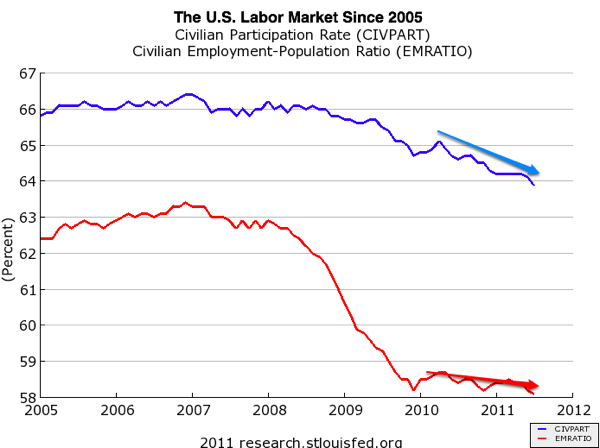
The employment-to-population ratio has fallen in the US. Therefore, the number of people being supported by each employed person has increased. While this is not an increase in the dependency ratio (which is defined by age cohorts), it has the same effect: fewer workers supporting more people. And yet, I’m not hearing the same urgency, the same concern to move heaven and earth to solve the actually existing problem.
I had a look at the NZ statistics, to see how we compare (courtesy of StatsNZ’s Infoshare). I can’t swear to have this exactly right, but this is what I found:
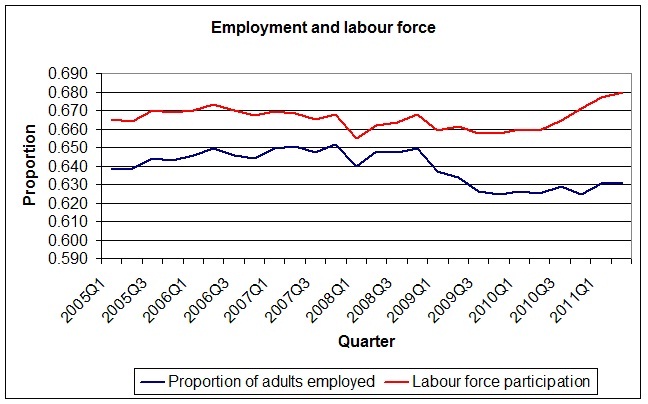
I calculated the proportion of adults employed as (all employed, seasonally adjusted) divided by (people aged 15+), and labour force participation as (all employed + registered job seekers) divided by (people aged 15+). The proportion of adults employed has, indeed fallen by 2 percentage points since 2008. Meanwhile, labour force participation has actually increased. That is, we have people ready and willing to go to work, but we aren’t using them.
Having fewer people employed to support our population is a concern for the future. However, it is also a problem now.